

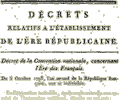

The French Revolutionary Calendar (or Republican Calendar) was officially adopted in France on October 24, 1793 and abolished on 1 January 1806 by Emperor Napoleon I. It was used again briefly during under the Paris Commune in 1871. The French also established a new clock, in which the day was divided in ten hours of a hundred minutes of a hundred seconds - exactly 100,000 seconds per day.
The calendar was adopted more than one year after the advent of the First Republic (there was no year 1), after a long debate involving the mathematicians Romme and Monge, the poets Chénier and Fabre d’ Eglantine and the painter David. The mathematicians contributed equal month division, and a decimal measures of time. The poets contributed the name of the days, choosing the names of plants, domestic animals and tools; the months rhyme three by three, according to the "sonority" of the seasons. The Eiffel Tower shown at right was built in commemoration of the French Revolution, and was built for the Paris World’s Fair in 1889.
The calendar was one of the great reforms undertaken by the national Convention, like the Metric system. Read the legislative texts which established le Calendrier Républicain.
What does a Republican year look like?
A year consists of 365 or 366 days, divided into 12 months of 30 days each, followed by 5 or 6 additional days. The months were:
| 1 Vendémiaire | 7 Germinal |
| 2 Brumaire | 8 Floréal |
| 3 Frimaire | 9 Prairial |
| 4 Nivôse | 10 Messidor |
| 5 Pluviôse | 11 Thermidor |
| 6 Ventôse | 12 Fructidor |
The year was not divided into weeks, instead each month was divided into three décades of 10 days, of which the final day was a day of rest. This was an attempt to de-Christianize the calendar, but it was an unpopular move, because now there were 9 work days between each day of rest, whereas the Gregorian Calendar had only 6 work days between each Sunday.
The ten days of each décade were called, respectively, Primidi, Duodi, Tridi, Quartidi, Quintidi, Sextidi, Septidi, Octidi, Nonidi, Decadi.
The 5 or 6 additional days followed the last day of Fructidor and were called:
| 1 Fete de la vertu (Celebration of virtue) |
| 2 Fete du genie (Celebration of genius) |
| 3 Fete du travail (Celebration of labor) |
| 4 Fete de l'opinion (Celebration of opinion) |
| 5 Fete des recompenses (Celebration of rewards) |
| 6 Jour de la revolution (Day of the revolution) (the leap day) |
Each year was supposed to start on autumnal equinox (around 22 September), but this created problems as will be seen below.
How does one count years?
Years are counted since the establishment of the first French Republic on 22 September 1792. That day became 1 Vendemiaire of the year 1 of the Republic. (However, the Revolutionary Calendar was not introduced until 24 November 1793.)
What years are leap years?
Leap years were introduced to keep New Year’s Day on autumnal equinox. But this turned out to be difficult to handle, because equinox is not completely simple to predict. Therefore a rule similar to the one used in the Gregorian Calendar (including a 4000 year rule) was to take effect in the year 20. However, the Revolutionary Calendar was abolished in the year 14, making this new rule irrelevant.
The following years were leap years: 3, 7, and 11. The years 15 and 20 should have been leap years, after which every 4th year (except every 100th year etc. etc.) should have been a leap year.
The historicity of these leap year rules has been disputed. One source mentions that the calendar used a rule which would give 31 leap years in every 128 year period.
How does one convert a Republican date to a Gregorian one?
The following table lists the Gregorian date on which each year of the Republic started:
| Year 1: | 22 Sep 1792 | Year 8: | 23 Sep 1799 |
| Year 2: | 22 Sep 1793 | Year 9: | 23 Sep 1800 |
| Year 3: | 22 Sep 1794 | Year 10: | 23 Sep 1801 |
| Year 4: | 23 Sep 1795 | Year 11: | 23 Sep 1802 |
| Year 5: | 22 Sep 1796 | Year 12: | 24 Sep 1803 |
| Year 6: | 22 Sep 1797 | Year 13: | 23 Sep 1804 |
| Year 7: | 22 Sep 1798 | Year 14: | 23 Sep 1805 |
