

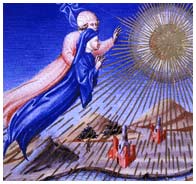
Illuminations of Dante’s Divine Comedy by Giovanni di Paolo (15th century)
Dante and Beatrice reach the sun, shown as a golden wheel sending golden rays to the landscape below. The Sun, located in the middle of the orbs, with three lesser above and three below, like the heart in the middle of the body, or a wise king in the middle of his kingdom.
- A day, which is the time from one sunrise to the next sunrise — one complete rotation of the Earth.
- A year, which is approximately 365.24 days — one complete orbit of Earth around the Sun.
- A month, which is approximately 29.53 days — one complete orbit of the Moon around the Earth.
Since these time spans are not easily divided, calendars have always been imperfect. Some were rooted in tradition, while others evolved as humankind gained a greater understanding of science and astronomy. Some calendars, like the Christian calendar (which is the primary calendar in use today) focused on the Earth’s orbit. Others, like the Islamic calendar, focused on the Moon’s orbit. Still others, like the Jewish calendar and Chinese calendar, combine both.
More details
Most calendars are based on astronomical events. From our perspective on Earth, the two most important astronomical objects are the Sun and the Moon, which is why their cycles are very important in the construction and understanding of calendars.
Our concept of a year is based on the earth’s motion around the sun. The time from one fixed point, such as a solstice or equinox, to the next is called a tropical year. Its length is currently 365.242190 days, but it varies. Around 1900 its length was 365.242196 days, and around 2100 it will be 365.242184 days. (This definition of the tropical year is not quite accurate; see astronomic issues for more details.)
Our concept of a month is based on the moon’s motion around the earth, although this connection has been broken in the calendar commonly used now. The time from one new moon to the next is called a synodic month, and its length is currently 29.5305889 days, but it varies. Around 1900 its length was 29.5305886 days, and around 2100 it will be 29.5305891 days.
Note that these numbers are averages. The actual length of a particular year may vary by several minutes due to the influence of the gravitational force from other planets. Similarly, the time between two new moons may vary by several hours due to a number of factors, including changes in the gravitational force from the sun, and the moon’s orbital inclination.
It is unfortunate that the length of the tropical year is not a multiple of the length of the synodic month. This means that with 12 months per year, the relationship between our month and the moon cannot be maintained.
However, 19 tropical years is 234.997 synodic months, which is very close to an integer. So every 19 years the phases of the moon fall on the same dates (if it were not for the skewness introduced by leap years). Nineteen years is called a Metonic cycle (after Meton, an astronomer from Athens in the 5th century B.C.E.).
So, to summarize: There are three important numbers to note:
A tropical year is 365.24219 days. A synodic month is 29.53059 days. 19 tropical years is close to an integral number of synodic months.
The Christian calendar (Gregorian calendar) is based on the motion of the earth around the sun, while the months have no connection with the motion of the moon.
On the other hand, the Islamic calendar is based on the motion of the moon, while the year has no connection with the motion of the earth around the sun.
Finally, the Jewish calendar combines both, in that its years are linked to the motion of the earth around the sun, and its months are linked to the motion of the moon.
See related information in another exhibit, Daylight Saving Time.
